CustID
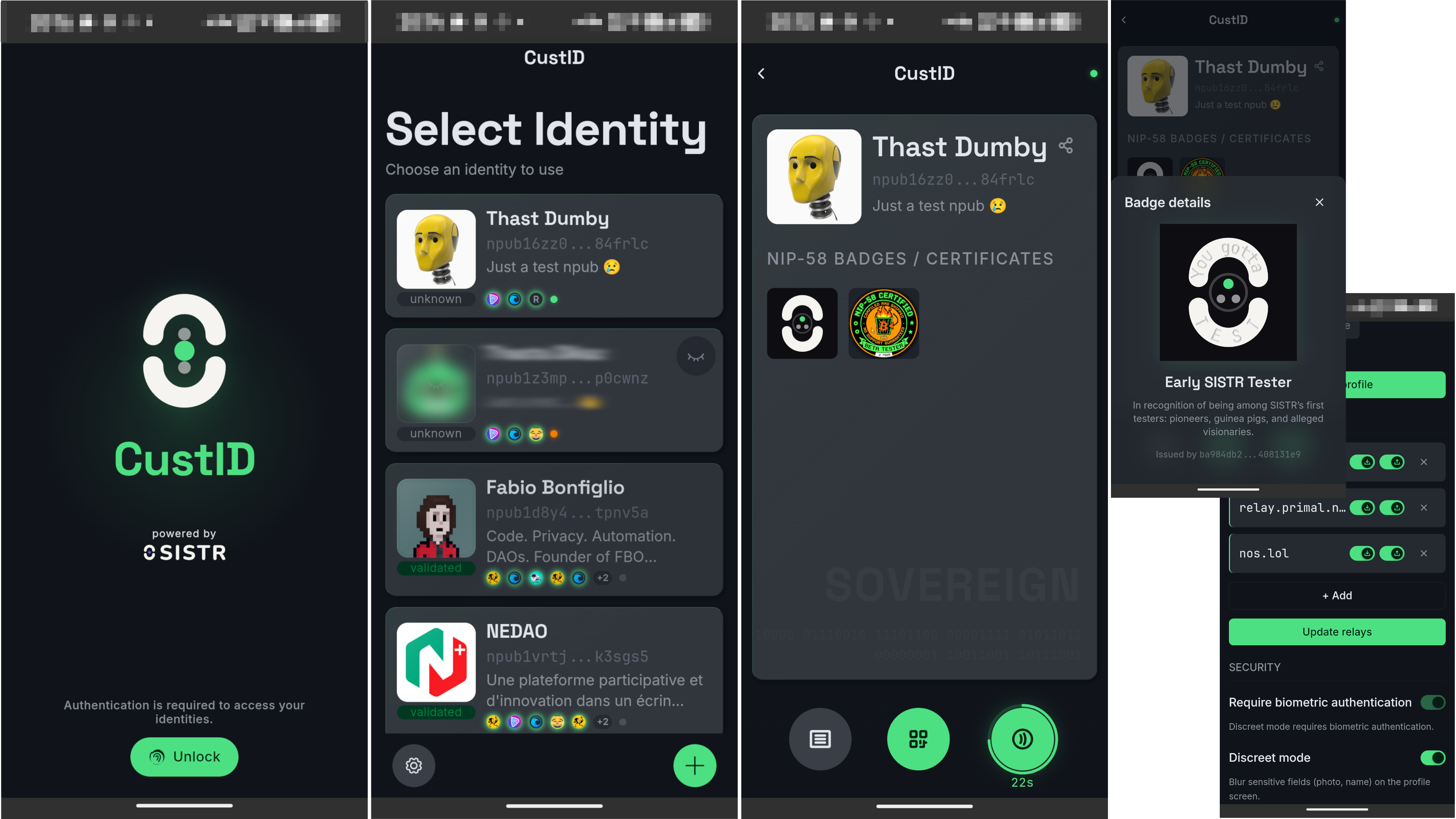
MVP beta, GPLv3A mobile identity wallet and vault: a NIP-46 bunker, key manager and signer, with NFC and QR challenge/response and hardware-backed key storage. It is the sovereign key holder that the rest of the flow builds on.


Sovereign Interactions Stack for Trustless Relationships
SISTR is an open protocol built on top of Nostr. It lets you prove who you are, what you are allowed to do and what you hold, with a single tap or scan, without a central authority, without surveillance, and without ever handing over more than the fact you choose to reveal.
Built on Nostr keys you already control. Transport-agnostic. No trusted setup. Public domain (CC BY-SA 4.0).
The problem
Across the world, digital identity is converging on a single shape: a credential issued, held and verified through infrastructure you do not control. The European Union is mandating the EUDI Wallet. Switzerland is rolling out its state e-ID (SWIYU). Know-Your-Customer and so-called anti-money-laundering rules keep expanding into ordinary, everyday interactions.
Each of these systems is defensible on its own. Taken together they push the same direction: every proof of who you are routes through a central issuer or registry that can log it, correlate it, suspend it, or be compelled to hand it over. Convenience is real. So is the quiet accumulation of a complete, linkable record of where you go, what you join and what you are allowed to do.
An issuer or registry that can verify you can also revoke, throttle or surveil you, and can be coerced into doing so.
Every check leaks more than a yes or no: who asked, when, where, and tied to a stable identifier that follows you everywhere.
Your "identity" lives in someone else's system. Access is granted to you, not held by you, and can be taken away.
Why Nostr
Most "decentralized" identity still leans on something you do not ultimately control: a hosting instance, a registry, a resolver, a provider that can rename, suspend or de-list you. Nostr starts from the opposite premise. Your identity is a cryptographic keypair you generate and hold. No account, no issuer, no instance. Just a key, and the proofs you sign with it.
As Bitcoin is to money, Nostr can be to identity.
did:plc / did:web) ties your handle to a directory or a domain you must keep.What SISTR adds
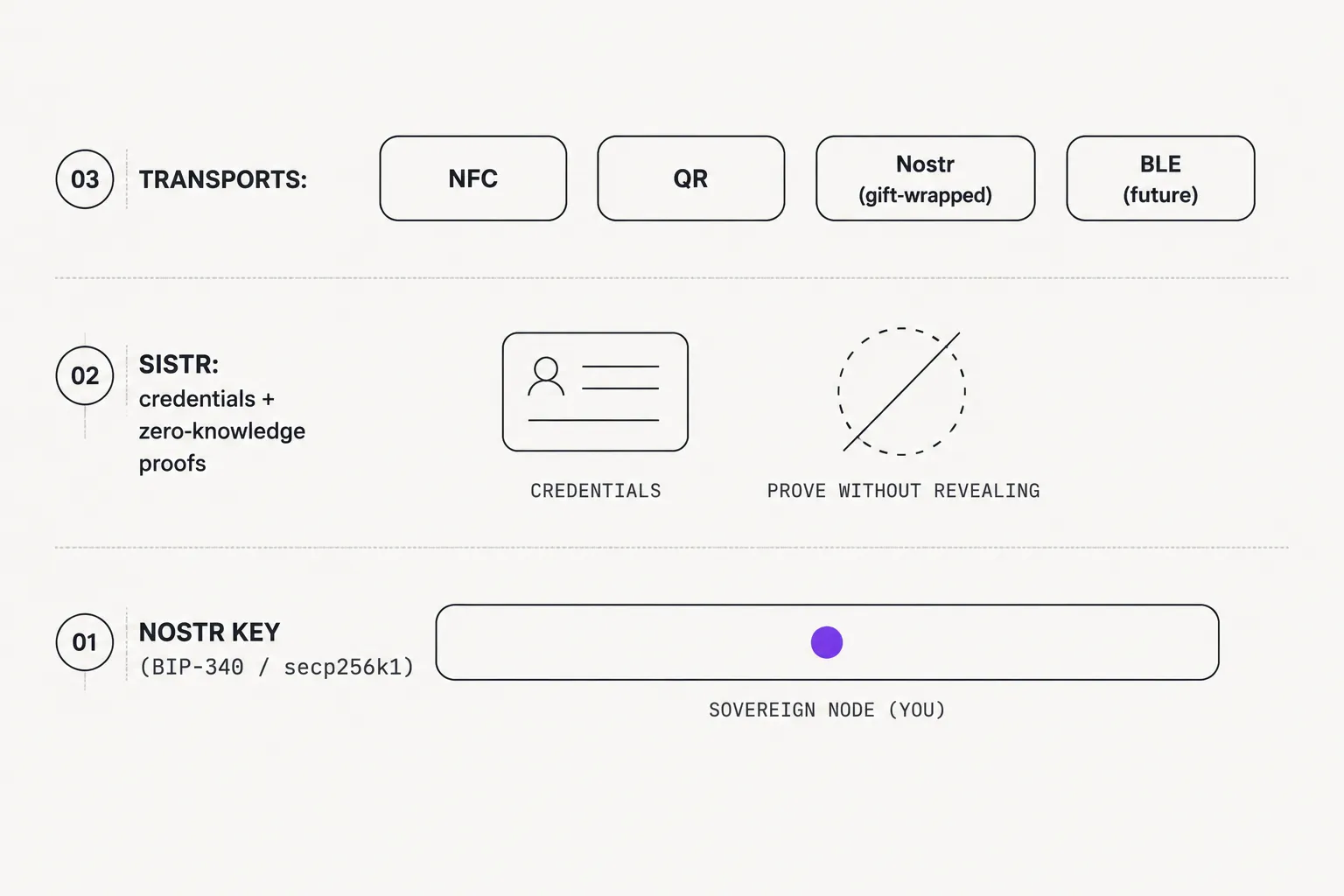
SISTR is not a competing stack and not a reinvention of cryptography. It is a thin, deliberately boring layer that turns the sovereign Nostr key into a practical identity tool for the situations where today's systems force you back into a central authority.
Prove your identity in person with an NFC tap or a QR scan using a challenge/response, with no network and no central identity provider in the loop.
Issue, hold and verify credentials that can expire and be revoked, and that can be issued privately, rather than ad-hoc signed notes.
Prove a fact about a credential (over 18, a member, holds a valid ticket) without revealing who you are or which credential you used.
One core that works across NFC, QR and Nostr-native gift-wrapped messages today, with room for BLE and other channels later.
How it works
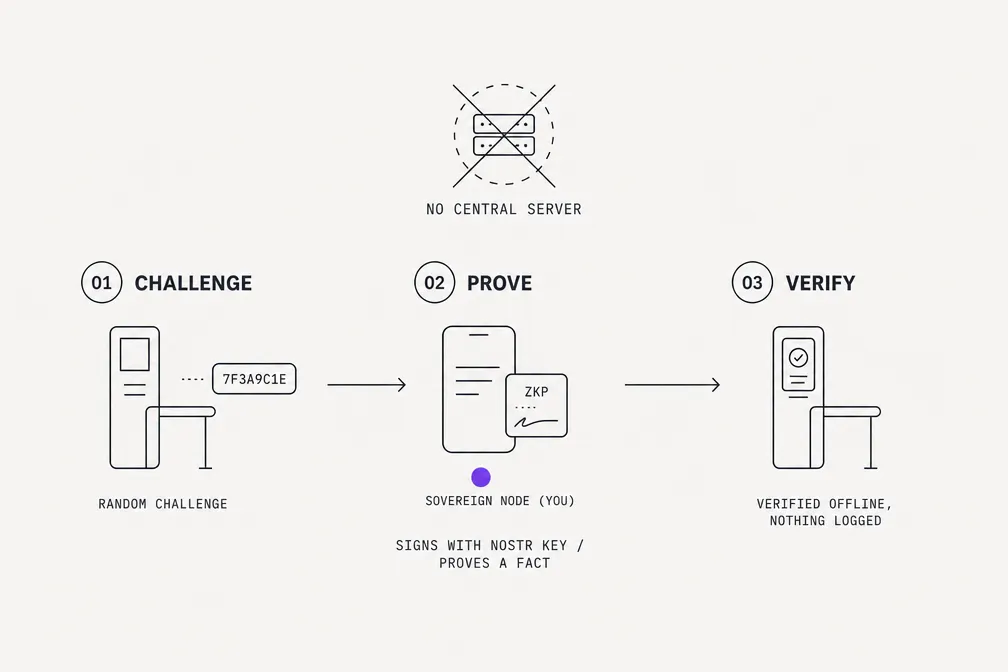
Under the hood it is a classic challenge/response, kept small enough to run on constrained hardware and simple enough to audit. The point is what is missing: no central identity provider, no online check, no stable identifier handed over.
The verifier (a door, a turnstile, a website, a small venue's phone) emits a fresh, random challenge over NFC, QR or a Nostr message.
Your device signs the challenge with your Nostr key, or produces a zero-knowledge proof over a credential, revealing only the fact being asked for.
The verifier checks the response locally. No round-trip to a central server, no account lookup, nothing logged to a third party.
Use cases
These are not hypotheticals bolted onto a protocol. They are the scenarios that shaped SISTR's design: everyday interactions where the convenient option today quietly forces you to identify yourself to someone who did not need to know.
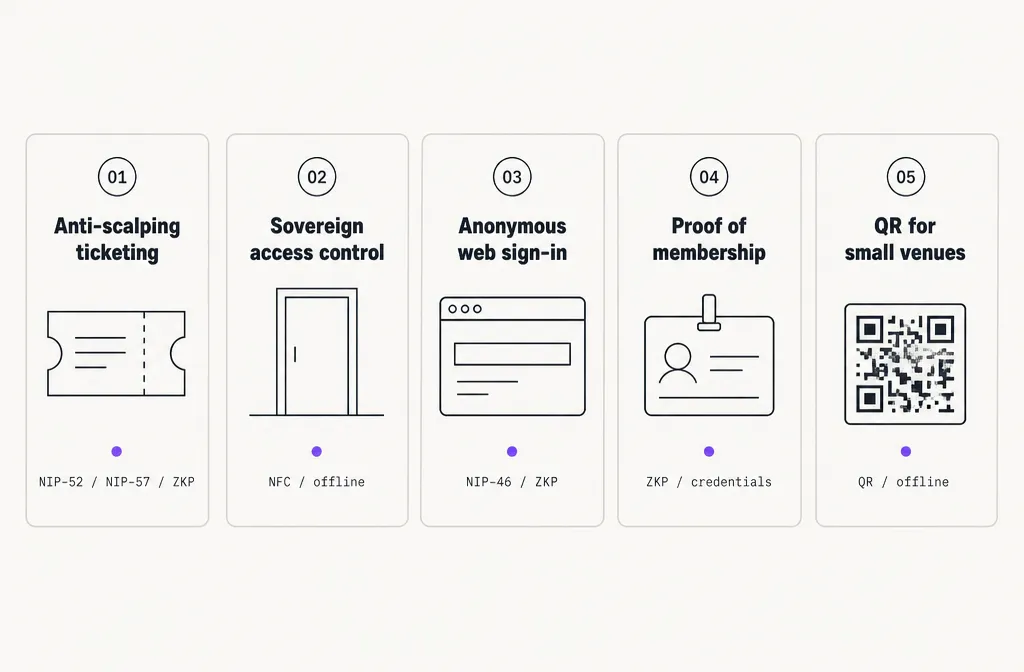
Sell and check event tickets bound to a credential, resistant to scalping, settled over Nostr-native payments, with no identity document collected at the door.
Replace plastic RFID badges with a single offline tap. No central badge server, no provider that can silently log every door you open.
Sign in to a site by proving a fact about a credential, without ever disclosing your public key or building a trackable account.
Prove you belong, qualify or are entitled, over 18, a member, a subscriber, without revealing who you are or which credential you hold.
No NFC hardware? A laptop as a BLE beacon or on-screen QR challenge runs the same offline flow with nothing more than a phone camera, or an hybrid route with just the verifier being online.
Real-life uses for Nostr badges as eligibility / allowance / pass. Because SISTR is built to be compatible with existing Nostr scheme from day one.
Reference implementations
SISTR is young and openly a work in progress. Rather than promise, we point at running reference implementations you can read, build and challenge today.
A mobile identity wallet and vault: a NIP-46 bunker, key manager and signer, with NFC and QR challenge/response and hardware-backed key storage. It is the sovereign key holder that the rest of the flow builds on.
A reference NFC reader built on a Raspberry Pi with Tinkerforge bricklets. The single-tap signature flow is operational end to end, showing the verifier side runs on constrained, off-the-shelf hardware, no proprietary terminal required.
Design principles
SISTR is not trying to be clever. It is trying to be small, auditable and impossible to quietly capture. Every principle below exists to remove a place where trust, or control, could creep back in.
Reuses the existing BIP-340 Schnorr key over secp256k1. No new key material, no second identity to manage.
The protocol does not care whether bytes travel over NFC, QR or Nostr. New channels plug in without touching the core.
Nothing depends on a ceremony, a coordinator or a privileged party to bootstrap. There is no one to trust by construction.
Designed to be implementable on small verifiers (ESP32, STM32, Raspberry Pi), not just powerful phones and servers.
Deliberately small and boring. The less there is, the less there is to audit, to break, and to abuse.
The protocol and brand are released under CC0. No license friction, no gatekeeper, free to fork and build on.
Get involved
SISTR is open, and while some parts are already mature and tested, others, such as anonymous credentials and ZKPs generated on handled devices, are still in early R&D stage. The most useful thing you can do is read the protocol, poke holes in it, and tell us where it is wrong.
SISTR's protocol specification is released under CC BY-SA 4.0. Use the SISTR name and logo to refer to the protocol, not to imply endorsement.